Automation Platform
Automation Platform overview
# Automation Platform overview [Cloud agents](/platform/) run on the Automation Platform. You define the work (a prompt or a skill) and what starts it, and the platform runs the agent and records what it did. For example, an agent can triage each new issue as it's filed, or start fixing a build the moment CI fails. If you're new to cloud agents, the [Cloud agents quickstart](/platform/quickstart/) gets you to your first run in about ten minutes. {/* Transition notice for the 2026-08-18 rename. Remove after 2026-09-15, when the CLI and web app take their new names and the old one stops appearing. */} :::note **Oz is now the Automation Platform.** Only the name changed. Your existing integrations, API keys, scheduled agents, and scripts keep working exactly as before — nothing to migrate. The `oz` CLI and the <a href=https://oz.warp.dev>Oz web app</a> keep the Oz name until September 15, 2026, which is why you'll still see it in commands and URLs. ::: <VideoEmbed url="https://youtu.be/poLkJhO7fdo" title={`Automation Platform cloud agents overview video`} /> ## How a run works Every run follows the same path, whatever starts it: 1. A **trigger** fires: a schedule, an integration event like a Slack mention or a CI failure, an API call, or a manual start. 2. Warp creates a **task**, the tracked record of the run. 3. The agent executes on a **host**, optionally inside an [environment](/platform/environments/) that defines its image, repos, and setup. 4. The task produces **outputs**: a pull request, a Slack reply, a report, or just a transcript and summary.  ## Integrations and triggers Every run starts with a trigger. [Integrations](/platform/integrations/) turn events in other tools into runs: mention @warp in [Slack](/platform/integrations/slack/) and the agent gets the message and its thread, or run agents inside your [GitHub Actions](/platform/integrations/github-actions/) workflows with your CI context. [Scheduled agents](/platform/triggers/scheduled-agents/) start runs on a cron schedule. For event sources Warp doesn't cover, receive the event in your own system and start the run through the [API](/reference/api-and-sdk/); it becomes a normal, fully tracked task. ## Tasks and tracking Warp tracks every run as a task: its status, transcript, and outputs stay available after the run finishes. Watch or steer a live run with [session sharing](/agents/local-agents/session-sharing/), browse history in the [management UI](/platform/managing-cloud-agents/), or query it from the [Oz CLI](/reference/cli/) and the [API](/reference/api-and-sdk/). Access control decides who can run, view, or intervene in tasks. To fan work out across parent and child agents, see [multi-agent orchestration](/platform/orchestration/). ## Environments An [environment](/platform/environments/) defines what a run needs: a Docker image with your toolchain, the repositories to clone, and setup commands. Automated runs (integrations, schedules, API calls) use an environment so every run starts from the same setup; interactive local runs use your machine as-is and don't need one. Define one environment per codebase and reuse it across triggers. ## Hosts A host is where the agent executes. By default runs execute on [Warp-hosted infrastructure](/platform/warp-hosting/), with nothing to set up. On Enterprise plans, [self-hosted runners](/platform/self-hosting/) keep code and execution inside your own network while Warp still tracks the runs. ## The CLI The [Oz CLI](/reference/cli/) starts and manages runs where there's no UI: CI jobs, scripts, and remote servers. Start a run with `oz agent run`, and it reports progress to Warp like any other task, so work that starts on a CI runner shows up alongside everything else your team runs. For interactive sessions, use [agents in the Warp app](/agents/). ## API and SDKs The [Oz API & SDK](/reference/api-and-sdk/) creates and inspects tasks over HTTP: submit a prompt with optional configuration, poll status, and fetch results with full provenance. Official [Python](https://github.com/warpdotdev/oz-sdk-python) and [TypeScript](https://github.com/warpdotdev/oz-sdk-typescript) SDKs add typed requests and responses, built-in retries, and consistent errors. Start with an SDK unless you need full control over your HTTP client. ## Secrets Agents often need credentials for APIs, databases, and MCP servers. Store them as [secrets](/platform/secrets/), and Warp injects them at runtime without exposing the values in logs or the UI. Secrets can be scoped to the whole team or to one person. ## Shared configuration Runs pick up your team's shared setup no matter what triggered them: [MCP servers](/platform/mcp/), [rules](/agents/capabilities/rules/), [saved prompts](/knowledge-and-collaboration/warp-drive/prompts/), and [environment variables](/knowledge-and-collaboration/warp-drive/environment-variables/). Configure these once and every trigger uses them. ## Warp Factories [Warp Factories](/factories/) builds on these pieces to run persistent, multi-agent development workflows: specialized cloud agents move each work item through triage, specification, implementation, and review. It's in Early Access. [Request access](https://www.warp.dev/factories/request-access) to use it with your team. ## Where to go next * [Cloud agents](/platform/) - what cloud agents are, how they get triggered, and how to run them with or without the Warp app. * [Cloud agents quickstart](/platform/quickstart/) - run your first cloud agent in about ten minutes. * [Environments](/platform/environments/) - define the toolchain and repos a run executes against. * [Oz API & SDK](/reference/api-and-sdk/) - drive the platform programmatically.Tell me about this feature: https://docs.warp.dev/platform/overview/How cloud agent runs work on the Automation Platform: triggers start tasks, tasks run in environments on a host, and every run leaves a record.
Cloud agents run on the Automation Platform. You define the work (a prompt or a skill) and what starts it, and the platform runs the agent and records what it did. For example, an agent can triage each new issue as it’s filed, or start fixing a build the moment CI fails.
If you’re new to cloud agents, the Cloud agents quickstart gets you to your first run in about ten minutes.
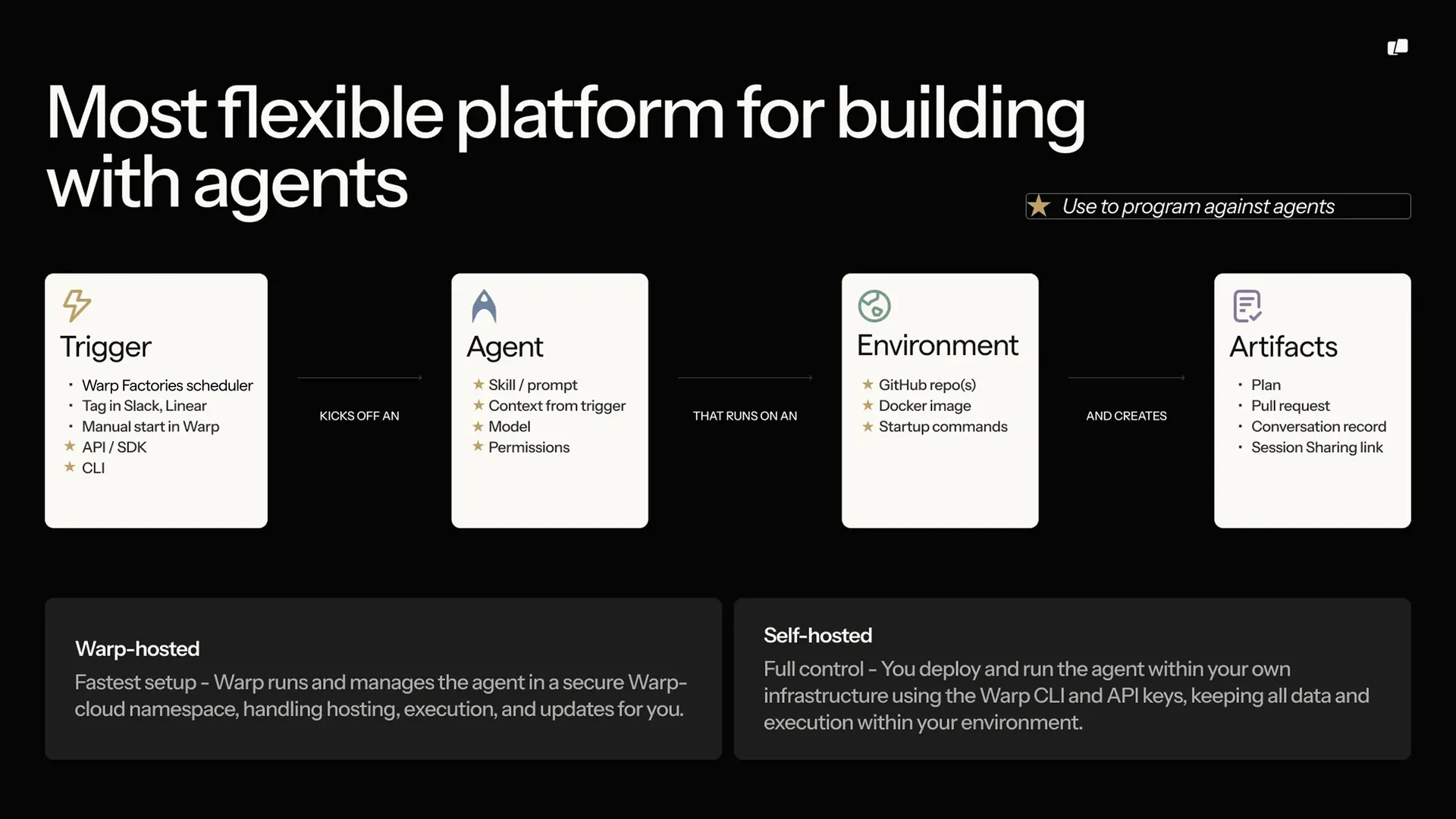
How a run works
Section titled “How a run works”Every run follows the same path, whatever starts it:
- A trigger fires: a schedule, an integration event like a Slack mention or a CI failure, an API call, or a manual start.
- Warp creates a task, the tracked record of the run.
- The agent executes on a host, optionally inside an environment that defines its image, repos, and setup.
- The task produces outputs: a pull request, a Slack reply, a report, or just a transcript and summary.
Integrations and triggers
Section titled “Integrations and triggers”Every run starts with a trigger. Integrations turn events in other tools into runs: mention @warp in Slack and the agent gets the message and its thread, or run agents inside your GitHub Actions workflows with your CI context. Scheduled agents start runs on a cron schedule. For event sources Warp doesn’t cover, receive the event in your own system and start the run through the API; it becomes a normal, fully tracked task.
Tasks and tracking
Section titled “Tasks and tracking”Warp tracks every run as a task: its status, transcript, and outputs stay available after the run finishes. Watch or steer a live run with session sharing, browse history in the management UI, or query it from the Oz CLI and the API. Access control decides who can run, view, or intervene in tasks.
To fan work out across parent and child agents, see multi-agent orchestration.
Environments
Section titled “Environments”An environment defines what a run needs: a Docker image with your toolchain, the repositories to clone, and setup commands. Automated runs (integrations, schedules, API calls) use an environment so every run starts from the same setup; interactive local runs use your machine as-is and don’t need one. Define one environment per codebase and reuse it across triggers.
A host is where the agent executes. By default runs execute on Warp-hosted infrastructure, with nothing to set up. On Enterprise plans, self-hosted runners keep code and execution inside your own network while Warp still tracks the runs.
The CLI
Section titled “The CLI”The Oz CLI starts and manages runs where there’s no UI: CI jobs, scripts, and remote servers. Start a run with oz agent run, and it reports progress to Warp like any other task, so work that starts on a CI runner shows up alongside everything else your team runs. For interactive sessions, use agents in the Warp app.
API and SDKs
Section titled “API and SDKs”The Oz API & SDK creates and inspects tasks over HTTP: submit a prompt with optional configuration, poll status, and fetch results with full provenance. Official Python and TypeScript SDKs add typed requests and responses, built-in retries, and consistent errors. Start with an SDK unless you need full control over your HTTP client.
Secrets
Section titled “Secrets”Agents often need credentials for APIs, databases, and MCP servers. Store them as secrets, and Warp injects them at runtime without exposing the values in logs or the UI. Secrets can be scoped to the whole team or to one person.
Shared configuration
Section titled “Shared configuration”Runs pick up your team’s shared setup no matter what triggered them: MCP servers, rules, saved prompts, and environment variables. Configure these once and every trigger uses them.
Warp Factories
Section titled “Warp Factories”Warp Factories builds on these pieces to run persistent, multi-agent development workflows: specialized cloud agents move each work item through triage, specification, implementation, and review. It’s in Early Access. Request access to use it with your team.
Where to go next
Section titled “Where to go next”- Cloud agents - what cloud agents are, how they get triggered, and how to run them with or without the Warp app.
- Cloud agents quickstart - run your first cloud agent in about ten minutes.
- Environments - define the toolchain and repos a run executes against.
- Oz API & SDK - drive the platform programmatically.